

Reportage Bruzz / Reportage BX1
The City of Brussels placed seals on a non-hotel tourist accommodation in the centre of Brussels this Monday, 13 November 2023. This was reported by the Brussels press.
The reports by Bruzz and BX1 call for several comments:
- First of all, we welcome the much more nuanced report by BX1, which gives a voice to the main stakeholders concerned (the tourists and the serviced residence sector) and mentions the forthcoming European regulation of the sector.
- Let us return to the journalist’s stigmatizing introduction in Bruzz24:
- “The owner was renting out rooms illegally to tourists.”
- The term “illegal” is often used indiscriminately by critics of the serviced residence sector. However, it is important to distinguish between the full spectrum of illegality within which different types of actors operate. Figure 1 below illustrates three different actors. They are all “illegal,” but one can logically agree that it would be better to remove actor 3 from the sector rather than actors 1 and 2 …
- The term “illegal” is often used indiscriminately by critics of the serviced residence sector. However, it is important to distinguish between the full spectrum of illegality within which different types of actors operate. Figure 1 below illustrates three different actors. They are all “illegal,” but one can logically agree that it would be better to remove actor 3 from the sector rather than actors 1 and 2 …

- “The majority of actors in Brussels are professional operators who manage multiple properties.”
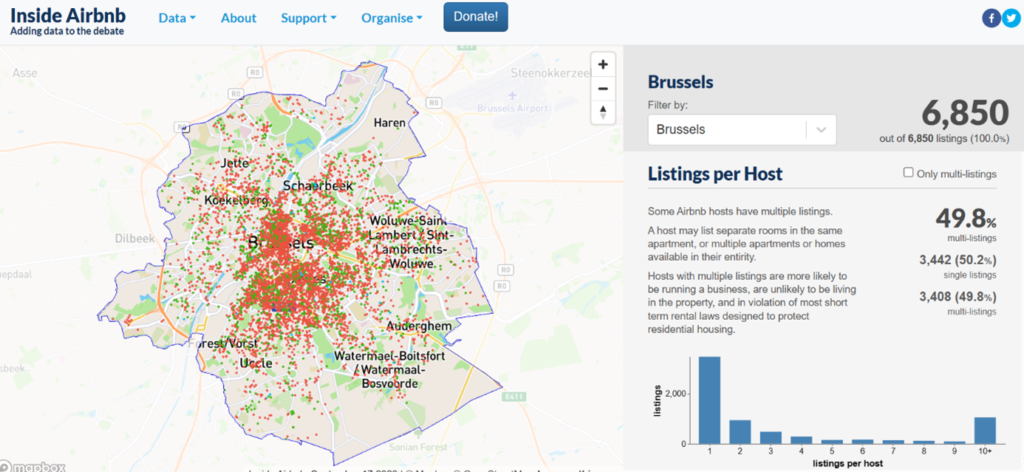
- Figure 2 calls for nuance regarding this statement. By consulting Inside Airbnb for the Brussels-Capital (Region), we see that 50% of operators have only one unit listed on Airbnb. It is also important to understand that operators managing multiple units may simply act as “property managers” or concierge services; these operators are therefore not necessarily multi-property owners, but rather enable individual owners to generate income—whether to maintain their purchasing power or to have sufficient means to maintain their property.
- Figure 2 calls for nuance regarding this statement. By consulting Inside Airbnb for the Brussels-Capital (Region), we see that 50% of operators have only one unit listed on Airbnb. It is also important to understand that operators managing multiple units may simply act as “property managers” or concierge services; these operators are therefore not necessarily multi-property owners, but rather enable individual owners to generate income—whether to maintain their purchasing power or to have sufficient means to maintain their property.
- Finally—and this is of course the most sensational claim when expressed in this way without nuance—“the activity of these serviced residence professionals constitutes a threat to the housing market.” We will return in detail to this housing issue later in this section.
Next, let us return to the statements made by the Alderman for Urban Planning, Ms. Maes:
- The Alderman first points out that Airbnb is intended only for private individuals who rent out their apartment/house in its entirety or a room in their apartment/house, for a period of up to 120 days.
It should first be clarified that the category “hosted accommodation” (= one or more rooms in an apartment or a house) under the ordinance of 8 May 2014, according to Article 10 – §1 – 2° c), stipulates that the (part of the) accommodation made available to the tourist must be available to host tourists for at least four months per year (minimum 120 days). By contrast, a serviced residence (= the entirety of an apartment or a house) in which the operator has established their primary residence may indeed only be rented out for a maximum of 120 days per year.
But more fundamentally, it should be recalled:
- that serviced residences were being rented out in their entirety all year round long before the advent of Airbnb (well before 2015).
- that tourists’ consumption habits are evolving, and that—certainly following the COVID crisis—many tourists are seeking greater autonomy and do not necessarily wish to share their accommodation with a resident, not to mention tourists’ increasing expectations regarding the quality of the services provided.
- that these claims do not take into account the demand for serviced residences at all (see the European Commission figures in the “Statements” section of the website), namely: will Brussels have enough residents willing and able to engage in sharing or making their homes available? Is this category of the population not limited to a certain type (e.g. expatriates), which could unfortunately result in a concentration of supply during certain periods of the year?
- Next, the Alderman appears to suggest that the activity is predominantly professional in Brussels, and more broadly across all municipalities of the Brussels-Capital Region. We can therefore state that this claim is incorrect and refer to our argumentation above and to Figure 2.
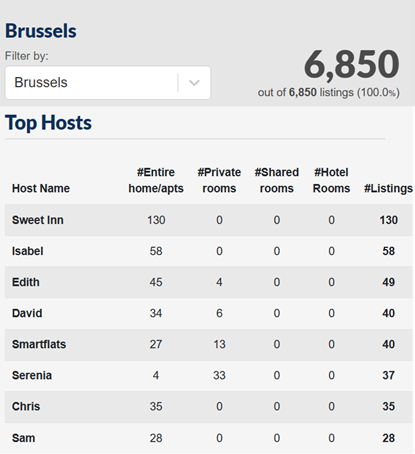
- What is even more striking is that, according to the Alderman, many companies would be operating more than 100 units, which does not align with the City’s plans. First, one may question—based on Figure 3—the accuracy of this statement (in fact, only one operator would have more than 100 units). More importantly, it should be noted that the Brussels-Capital Region does not authorize—under its current regulations, and likely under the future ones, which will be challenged—any professional operator. Indeed, the Brussels-Capital Region only allows the two aforementioned categories (Serviced residence < 120 days; Hosted accommodation > 120 days), for which it is indeed required, as the Alderman points out, to have established one’s primary residence at the property.
- One may question this position of the City of Brussels, which is relatively unique in Europe, given that Brussels is far less under tourism pressure than other major European cities (see the Brussels–Barcelona comparison in the “Statements” section of the website). Attempting to divide private individuals and professionals in this way is regrettable. It should therefore be stated clearly: if renting out 100 units is not desired by the City (and the Region), unfortunately the same applies to renting out a single unit for more than 120 days per year. Is it truly reasonable for the Brussels Authorities to believe that they will be able to completely prohibit such a professional activity under European law, when this regulated professional activity exists everywhere else?
- Finally, it is important to revisit the “threat” that the activity of renting serviced residences allegedly poses to housing. Where are the Alderman’s figures to support this claim? How can she assert that the policy of prohibiting the rental of serviced residences pursued by the Brussels majority will have a beneficial effect on the availability of reasonably priced housing for Brussels residents?
- It seems obvious to us that the drastic reduction in the supply of serviced residences will have an impact on visitor numbers in Brussels (hotel room prices that are off-putting for many tourists; the loss of a segment of the offer well suited to certain profiles of visitors—families, groups of friends, etc.—see the tourists’ comments in the BX1 report). This reduction in the supply of serviced residences will also inevitably generate job losses across an entire ecosystem (laundry services, cleaning, associated services, etc.), as well as in the restaurant and café sector, which will lose customers. However, the tangible effects of this prohibition policy on the Brussels housing market remain to be demonstrated.
- We refer the reader to useful documents to help form their opinion on this complex issue:
- The article published in Le Soir on 19 October, “Why have housing rents increased?”, which does not in any way point to the impact of serviced residences, but rather to other factors. Its conclusion is crystal clear: “public housing stock must be expanded—particularly social housing—namely, a supply that moves beyond purely market-driven dynamics.”
- The Strategy& study by PwC for France, discussed in the “Study” section of our website, which clearly identifies vacant (abandoned/unoccupied) housing as the main source of the housing crisis and greatly relativizes the effects of the presence of serviced residences—see the conclusions on page 16. In this regard, it would be beneficial for the Government to continue on its current path (see the Le Soir article of 8 November 2023) and to somewhat relax its policy in order to effectively regulate (rather than prohibit) the serviced residence market, while carefully considering the constraints and opportunities.
Finally, the intervention of researcher Hugo Périlleux-Sanchez gives rise to the following reactions:
- The rental of serviced residences “is clearly not the primary factor in the housing crisis in Brussels” … It would be useful—following the example of the very recent PwC study for France mentioned above—for such an analysis to be carried out for the Brussels-Capital Region: what are the factors and the levers to resolve the housing crisis in the pursuit of an overall optimum?
- One can reasonably assume, in a supply-and-demand logic, that the supply of tourist accommodation will develop in proportions that reflect demand. The differentiated figures put forward by the researcher clearly demonstrate the sound basis of the judgment of the Court of Justice of the European Union in the Cali Apartments case: proportionate rules cannot be justified in globo, nor at the level of a municipality, but rather on a neighbourhood-by-neighbourhood basis.
- while it can be understood that the sector needs to be regulated in neighbourhoods under high tourism pressure, the supply in these areas should nevertheless not be stifled. Moreover, the authorities should also consider other aspects in terms of urban planning for historic city-centre neighbourhoods and the balance between different functions (housing, hotels, serviced residences, retail, hospitality, etc.), through a more granular Regional Land Use Plan (PRAS) revisited under the Share the City project.
Let us also highlight a few elements from the BX1 report:
- when the Alderman states that “each Airbnb unit rented on a short-term basis is a unit that a Brussels resident cannot rent or buy,” she could just as well say that “each unit that will be removed from the short-term rental market through the (Regional) prohibition policy is a unit that a tourist will no longer be able to rent, which will contribute to the risks mentioned above: an increase in hotel room prices or tourists shifting to other destinations (as indeed confirmed by those directly concerned), with potentially disastrous consequences for the Brussels economy.” With a bit of political courage, is there really no way to find a better balance?
- As regards the harmonisation of rules at the European level, the journalist is getting ahead of things… The European Commission’s regulatory proposal is primarily aimed at increasing data transparency in order to define proportionate rules for the market. More information is available in our News section.